



 Cornell began as a stunningly radical place: a force for the democratization of higher education in the United States. The new university exiled pedantry and opened its academic doors to a wide array of students, setting itself against mid-nineteenth century eastern universities that served middle-class, elite, white Protestant males—and few of them, at that.
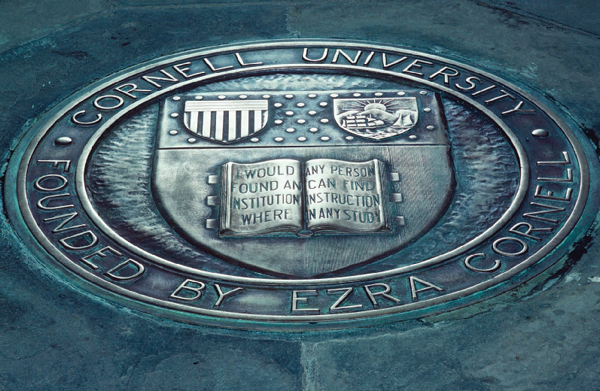
Why Ezra and Andrew’s word choice was no accident
Cornell began as a stunningly radical place: a force for the democratization of higher education in the United States. The new university exiled pedantry and opened its academic doors to a wide array of students, setting itself against mid-nineteenth century eastern universities that served middle-class, elite, white Protestant males—and few of them, at that. Cornell University aided in the development of the modern research institution that we take for granted today.
This, of course, did not please everyone. Most disdainful of Cornell were those who had a stake in the older models: many of the presidents, deans, faculty, and alumni of the older schools, as well as nearby ministers.
But the creation of Cornell positively thrilled others.
In 1865, when Andrew Dickson White wrote the Cornell charter, rather than using the word male or even student, he used the word person. White wanted to link the new university to the New York public school system, to be a place to which its graduates would aspire, and who would teach in the state’s public and private schools after graduation. One of Ezra Cornell’s primary concerns was that the new university be open to boys of limited economic background—much like his own had been—who would not have aspired to a university education, never before having had a place that would consider them.
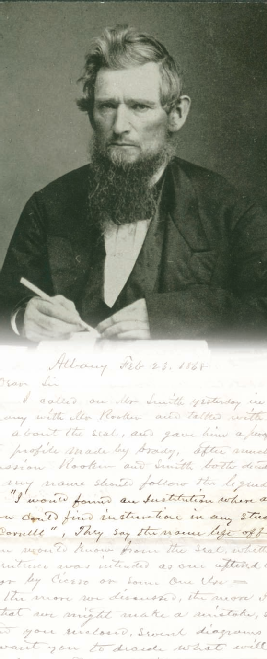
The word person suited both of the University’s founders. And while some scoffed, many people responded enthusiastically to this broad invitation. Luckily for us, the letters of advice and those of inquiry that came to Cornell and White are available in the University’s remarkable archival collection. In them, we can hear the voices of the applicants as they made their appeals to the University during its earliest years.
"Could I enter Cornell?" asked one young man. He explained that by the time the University opened—in a brief two months—he would have learned both math and spelling. Others wrote asking whether remedial lessons would be available; quickly the University added the phrase "academically qualified" to its admission requirements.
"Could I work my way through?" asked a young man, having no money to pay the tuition of twenty dollars. Others explained that they would have to work for their room and board, were they to come study in Ithaca. One applicant asked about possible admission "for a man minus a right arm (left on the battlefield); the other," he wrote, surely without intending a pun, was "handy." And what "facilities might there be for a married man, a machinist by trade"? Might he come to study? Willard Fiske warned White that every day some "skilled blacksmith, tanner, or brewer calls on me—desirous of entering the University." He described one applicant as a "brawny fellow"— not the usual description of a scholar—interested in exchanging the forge for study. Fiske cautioned White that he should be prepared for several "deputations from the trades."
Might foreign students apply, asked a man in England on behalf of his son. The charter said there was to be "no bar concerning place of origin," and in the University’s first twenty years, 125 foreign students received Cornell degrees and many others came to study for a year or two without graduating. They came from a wide range of countries: most from Canada, but others from Brazil, Japan, Russia, Serbia, Turkey, Bulgaria, and Cuba. In Ezra Cornell’s 1870 diary, he notes that there were students at the University from Texas, Tennessee, Sweden, Hungary, and Japan—all far from Ithaca, all evidence that the University’s mission was attractive to many.
Did person mean "slightly colored," asked a man from Bermuda who wrote on behalf of a young man desirous of gaining a professional education. From Ohio a man wrote on behalf of a "bright colored lad." Could he attend the University? "Send him," wrote Ezra Cornell. There was no racial bar at Cornell, and the application and registration forms never asked about race. The only qualification was always academic preparation. Cornell graduated its first African American students in 1890; there were others at the University earlier who did not take degrees—a common pattern for many students at a time when a college degree was not required for entrance to professional schools or most careers.
In 1874—the last year of Ezra Cornell’s life—members of the New York State Senate raised questions about the University’s policies, calling Cornell and White to Albany to testify. Over the course of the week, the senators asked about all aspects of the new institution. One exchange concerning the plan to invite different preachers to speak at Sage Chapel went like this:
Senator: Let me understand what you mean by various: do you mean from all denominations?
White: From all denominations, yes.
Senator: From all religious denominations?
White: From all religious denominations.
Senator: Each man to be at liberty to conduct the services according to his own method?
White: Yes.
Senator: Would you include in that, I suppose Jews, as well as Christians?
White’s response is important, for there were many colleges that refused entry to Jews, and others that restricted their numbers. He said: "That would certainly be in accordance with the spirit of our charter. We have several Jewish students in our institution and among them some of our best students, and I would never sanction anything which would infringe on their privileges, deprive them of their rights, or tend to degrade them in any manner."
And what about women? In 1848 Elizabeth Cady Stanton had written in the "Declaration of Sentiments" that men in the United States had denied "all faculties of obtaining a thorough college education, all colleges being closed to her." While Stanton was right about schools in the East, Oberlin College in Ohio had admitted women soon after its founding in 1833, although they received a certificate at the end of their studies rather than a degree.
From Ohio, a man wrote on behalf of a ‘bright colored lad.’ Could he attend the University? ‘Send him,’ wrote Ezra Cornell. There was no racial bar at Cornell, and the application and registration forms never asked about race. The only qualification was always academic preparation.Cornell and White believed, for somewhat different reasons, in equality of opportunity for females. At first White thought that abridgments of classical works would be sufficient for women, but the Rev. Samuel May of Syracuse quickly set him straight. Mr. Cornell thought that women needed to learn industry in a factory setting, perhaps overseen by Mrs. Cornell. White soon set him straight.
Many people wrote to urge the founders to admit women, including Susan B. Anthony and Matilda Joslyn Gage, advocates for reform; Maria Mitchell, the astronomer; and Lyman Fowler, the phrenolo-gist. Ezra Cornell hoped to see 1,000 women at the University—a staggering number of female students to contemplate at the time. White believed that women would have a civilizing influence on the young men and welcomed them as students. There were those, however, who opposed women’s education, especially the education of women alongside men. Coeducation would make women more masculine, worried some, rendering them "unsubmissive" and therefore unmarriageable. Catherine Beecher warned of the dangers of "spooning" and immoral contact.
Dr. Edward Clarke of Harvard Medical School wrote a book, published in 1872, entitled Sex in Education, in which he made the argument that study, like all strenuous activities, required an increased flow of blood to the area on which there was stress, and were women to engage in intellectual pursuits their blood would flow to the brain, thereby shrinking the uterus. "It would stop the population," Clarke and his supporters proclaimed. Other worries concerning coeducation had to do with the damaging effect on men if women students were to do better than they did.
But the women for whom the word person opened long-closed doors were thrilled. Two female teachers from Sherwood, New York, wrote that they were "gratified to know your institution, so noble, and possessing advantages so great, is open to women." Boldly, they announced, "We wish to enter."
In a series of letters directed to President White, one correspondent poured out her feelings. "If you were a woman and had been disgusted, mortified, and exasperated as I have been," she wrote, "by the talk of educated men about our capacity—or incapacity, rather—I might make you understand the satisfaction, gratitude, and delight with which I read your report on coeducation."
And a father from Cambridge, Massachusetts, wrote to President White to thank him for his "kind letter" considering his daughter’s request to become a student at Cornell. He noted that White’s response came in contrast to the "insulting coolness with which [Harvard President Charles William] Elliot treated her application." Mary Holman Ladd graduated from Cornell in 1875 with an AB and in 1878 with a master’s degree.
Cornell University welcomed any academically qualified person because it was the right thing to do, at a time when opportunity was limited to the astounding standard of being white, male, Protestant, and able to afford college. Women’s colleges associated with some of our great eastern universities opened only around the turn of the twentieth century, and equal admission for women came only in the late Nineteen Sixties and Seventies when male-only colleges bent to massive societal changes, Civil Rights legislation, and the requirements of Title IX—one hundred years after Cornell had set its course.
At Cornell from the very start, person has meant Ezra Cornell’s "poor boys," foreign students, and African Americans. It has meant state scholars and those from all economic backgrounds. It has meant students of all races and both genders, and those of any, and even of no, religious affiliation. Living up to this ideal has not always been easy, but this is a legacy worth knowing about. It is what made Cornell University unique from the very beginning.
Carol Kammen, the Tompkins County historian, taught Cornell students about the history of their university for more than twenty years and is the author of Cornell: Glorious to View and First-Person Cornell. This essay was adapted from a talk she gave at the 2008 Mid-Winter Meeting of the Cornell Association of Class Officers.
{mov}Ezras_Song{/mov}
Reader Submission:
I just finished reading Carol Kammon’s CAM|Online article, "Any Person." It was a wonderful piece of writing. Earlier today my uncle, Bill Doerler, also a Cornell alumnus, wrote:
"Please send this editor your Any Person Cornell song, it fits. Uncle Bill"
Uncle Bill is referring to a song I wrote and shared with him last summer when I returned home from Cornell Reunion 2007 (my 25th class reunion year). After listening to and joyfully (or sometimes tearfully) singing along with many of the "old songs," I was left wondering, are there new Cornell songs that will someday be part of the Cornell repertoire or some future "Songs of Cornell" songbook? Surely, the traditional fight songs, drinking songs, and reminiscent anthems will have a place as long as the great community singing tradition of Cornell survives. Still, it seems there may be room for songs which are less focused on Cornell’s victories and superior position "far above Cayuga’s waters" and which allow for a more contemporary styling and sentiment.
Prior to the reunion I had been reading about Cornell’s celebration of the 200th anniversary of Ezra Cornell’s birth. I also recalled a 2007 Cornell flyer that used an abbreviated version of Ezra’s famous, "I would found an institution…" quotation (shortened to "any person, any study"). So I attempted to set Ezra’s historic words to music and, following Uncle Bill’s request, thought I would share that effort with you. That quotation has been very powerful for me and I hope this song does it justice.
Here are an MP3 version of the tune with a rhythm section-based accompaniment, along with a lead sheet in pdf format. I hope others will be encouraged to "pen" some new Cornell tunes.
John R. Whitney
Cornell Class of 1982