




President David Skorton describes the winning bid at the Cornell Alumni Leadership Conference in January.
Dan Huttenlocher can be forgiven for being a tad hyperbolic in describing the communications firestorm that erupted when he landed at LAX on the afternoon of Friday, December 16. “When I turned my phone back on, it literally melted with texts, e-mails, and messages,” Huttenlocher says, sitting in his Rhodes Hall office exactly one month later. “I had been in the air for hours, and it was like, ‘Where are you? Why can’t I reach you?'”
As Huttenlocher—then Cornell’s dean of computing and information science— soon learned, while he’d been en route from New York to L.A., the University’s odds of winning the hard-fought competition to build a graduate technical campus in New York City had improved enormously. Out of the blue, its chief rival—Stanford—had dropped out. That was spectacular news for Cornell—though it put the kibosh on Huttenlocher’s planned long weekend with family on the West Coast. “Basically,” he says, “I got on a plane and flew back to New York.”
By Monday, it was official: after an intense year-long process, Cornell had won the right to build an ambitious, industry-focused, two-million-square-foot applied sciences campus on Roosevelt Island. At a press conference at the Medical college announcing the decision, Mayor Michael Bloomberg—who initiated the competition and had final say over the winner—called the campus “game-changing.” And its ambitions are undeniably lofty: to transform how engineering is taught and practiced at Cornell; to raise the University’s profile at home and abroad; to create a campus unlike any in the world; to foster a New York City tech economy to rival that of Silicon Valley. “By adding a new state-of-the-art institution to our landscape, we will educate tomorrow’s entrepreneurs and create the jobs of the future,” Bloomberg said. “This partnership has so much promise because we share the same goal: to make New York City home to the world’s most talented workforce.”
The University’s bid for the project, formally dubbed CornellNYC Tech, was made in collaboration with the Technion, Israel’s premier technical institute. But it’s not a 50-50 split; the University is by far the major player. “The city has a contract 100 percent with Cornell,” says Engineering dean Lance Collins. “We own the project and all of the risks associated with it.” As Provost Kent Fuchs explains: “The physical campus is fully Cornell. Cornell will own the land and the facilities. We are putting in the funding to develop the site and the buildings, and therefore the campus is our responsibility.” The Technion partnership lies on the academic side: while some students will earn graduate degrees from Cornell University, others will pursue a master’s in applied science—in such fields as computer science, information science, and electrical and computer engineering—from the Technion-Cornell Innovation Institute, conferred by both institutions.
In addition to the rainmaking imprimatur of the Technion—whose alumni, Huttenlocher points out, have founded some sixty companies listed on the NASDAQ— Cornell had another ace in the hole: a $350 million gift to support the campus from Charles Feeney ’56. A Hotelie, Feeney made a fortune with his Duty Free Shoppers stores and has gone on to give away most of it, inspiring wealthy people like Bill and Melinda Gates to do the same. Over the years, his Atlantic Philanthropies foundation has donated more than $600 million to Cornell; the $350 million gift brings that total close to an even billion. In a statement from the foundation, Feeney called the tech campus “a once-in-a-generation opportunity to create economic and educational opportunity on a transformational scale.”
NYC Tech will unfold on a generational timeline: it won’t be fully built until 2037, at a total cost of more than $2 billion. But it’s also designed to have a fleetof- foot, start-up mentality—and in that spirit, classes will begin this fall, a mere eight months after the deal was signed. Temporary space will be rented—in Manhattan, not on Roosevelt Island—and the two dozen or so students will be drawn from those already enrolled in graduate programs, with classes taught by Ithacabased faculty. “You can think of it like the Cornell in Washington program,” says Huttenlocher, who has been tapped as the campus’s inaugural dean, “except that instead of being in Washington and focused on politics, it’s in New York and focused on tech.”
The essential role of NYC Tech is as an applied sciences campus: it’s all about facilitating the relationship between academia and industry. According to Huttenlocher, that reflects fundamental shifts in how higher education approaches computer science and engineering. “Twenty years ago, there were the people who did stuff in the real world and there were the academics in those fields, and the ties weren’t all that strong,” he says. “Some people went back and forth, but that wasn’t the norm; in fact, in some ways time spent out of academia damaged your career. Now it’s the converse, especially in computer science. Getting your research ideas out into industry is a huge plus for your academic career.” But Cornell’s isolated Upstate location has inherent limitations for partnering with industry. “Cornell produces technology at a rate commensurate with its stature and abilities,” Collins says. “Tompkins County is a very small sponge to absorb that amount of activity, so what happens is that it goes flying all over the place. It isn’t that we’re not doing it—but when we do it we’re feeding the Silicon Valley area; the Route 128 corridor in the Boston area; Austin, Texas; the North Carolina Triangle; and other hotbeds of technology, because they have that capacity.”
So when Bloomberg announced the tech campus competition in December 2010—offering a sizeable plot of city land plus up to $100 million in infrastructure improvements—the University jumped at it. “The opportunity was perfectly aligned with what we wanted to do as an institution, so it didn’t take long—like minutes— before we realized that we needed to go after this,” Collins says. “There was a defensive side to it as well, particularly as Stanford came in very strongly wanting to land in New York City. There was the sense that if we didn’t stand up to that, at some level we were conceding a huge amount to a competitor; in essence we were strengthening their hand and weakening ours at the same time.”
In formulating the University’s proposal— which had the enthusiastic backing of President David Skorton and the Board of Trustees, plus thousands of students and alumni—the major players were Fuchs, Collins, Huttenlocher, and Engineering associate dean Cathy Dove, MBA ’84. In a process that Dove calls “incredibly intense, fast-moving, exhilarating, and challenging,” they and their staff logged thousands of miles on the Campus-to-Campus bus and conducted innumerable meetings and fact-finding sessions; the University aimed to miss no opportunity to promote its plan. “At every step—and there were many steps— we tried to be the strongest,” Fuchs says. “There was an expression of interest that was due in March; we did a lot of work on it and it was just like a full proposal. Then there was a presentation in July about our expression of interest, and we spent weeks working on that and rehearsing it. So we were really over-prepared— the whole team, everybody. There were big media events in the city. There were breakfasts. We wanted to have a Cornell presence; anytime there was anything about this campus, we were there. We would send representatives to shake the mayor’s hand, to make sure Cornell was always visible.”
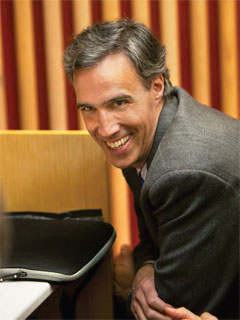
Former computing and information science dean Dan Huttenlocher is now dean of CornellNYC Tech.
Huttenlocher alone met with some 200 members of the city’s technology industry, asking what factors impede their business and how a university could help. “First and foremost was talent, just over and over again,” he says. “They had the sense that the very best people in technical fields tended to move to the West Coast when they graduated.” It’s a chicken-and-egg problem: it’s hard to draw talent to an emerging tech sector for the simple reason that it’s not an established tech sector. “One of the defining characteristics of those places is that there is a lot of cross-company interaction among people,” Huttenlocher says. “And that’s critical, because in the technology sector, start-up companies play a huge role—but ninety-nine out of 100 start-ups go belly-up. So if you’re thinking about a career, an individual start-up is the worst choice, because it’s almost certain you’ll be out of a job in a few years. But if there’s a strong ecosystem with lots of start-ups, then it’s a secure place to go, because somebody’s always going to be hungry for your skills.”
NYC Tech, which will feature office space for nascent businesses, is aimed to foster that sort of environment in New York City. As such, organizers say, it will have a different focus and feel from the Ithaca campus. The hope is that together, the two sites will offer the best of both worlds, to both students and professors. “We designed it so that it complements and doesn’t duplicate the Ithaca campus,” Collins says. “We think there are certain core strengths of being in Ithaca and there will be core strengths of being in New York, and faculty will want to be at one or the other—though some will go back and forth because of the nature of what they do. The New York campus is going to be focused on commercialization; it’s a place to be an entrepreneur. Not every faculty member has that aspiration. For those who do, it will be like heaven because it will have a tight coupling with the venture capital world, lots of industry on campus, and students who have this interest as well; it’s going to be a powerful engine. On the other hand, we do lots of fantastic research in Ithaca that doesn’t fit that commercialization mindset. Longer-term research—activities that will be commercial thirty to fifty years from now—won’t belong in New York either.”
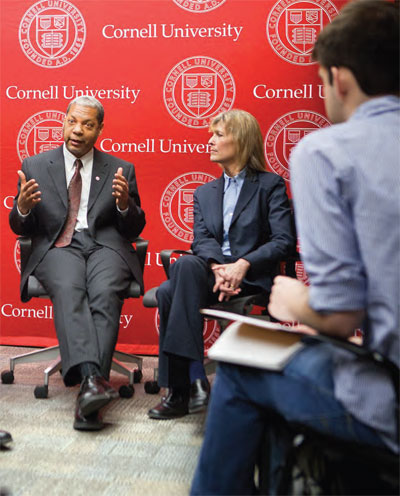
Engineering dean Lance Collins (left) and NYC Tech vice president Cathy Dove, MBA ’84, are interviewed about the project.
While many Cornellians support NYC Tech—more than 20,000 alumni signed a petition in favor of it, and both the undergrad and grad student assemblies passed resolutions endorsing it—the project has its detractors. Most vocally, critics of Israel’s actions in Palestine have decried the Technion’s role in the nation’s military-industrial complex; in a statement, one group of concerned Cornellians claimed that “more than any other university in Israel, the Technion, which is involved in the research and development of military and arms technology, is directly implicated in war crimes” and demanded that the University sever its ties with the institute. In a letter provided to CAM, H. William Fogle Jr. ’70 wrote, “My greatest concern about the Cornell-Technion partnership is that it expresses the University’s tacit approval of Israel and the security policies of the Jewish state—policies that most nations find criminal, in defiance of international law, and morally repugnant.”
Skorton counters that higher education offers the opportunity to transcend national boundaries and conflicts, calling it a way for people to “interact with each other despite what their governments are doing—despite whether their governments are even talking to each other.” Cornell, he says, “is in a very unusual, if not unique, position to bridge some of these gaps.” He notes that the Medical college is the only American institution to grant an MD degree overseas—in the Persian Gulf emirate of Qatar—and that Cornell has close ties to Saudi Arabia’s King Abdullah University of Science and Technology. “And now we have a partnership with one of the greatest entrepreneurial higher education organizations in the world, the Technion,” Skorton says. “So I am even stronger in my belief that we will benefit from working with colleagues who have the same goal: to improve life by discovery and innovation.” And, he adds, “we don’t use the actions of governments as criteria for whether we will interact with the people of those countries.”
But the Technion partnership hasn’t been the only cause for criticism. In the Daily Sun, ILR student Jake Walter- Warner ’12 argued that Cornell is going through a midlife crisis as it approaches its 150th birthday. “The NYC Tech campus,” he wrote, “is our billion-dollar bright red sports car.” In April, Moody’s Investors Service—while upgrading the University’s overall outlook from negative to stable— cited NYC Tech as a potential future liability. “Although the university has received a $350 million gift from a private foundation and a $100 million grant from New York City to support capital and operations of Phase I of the project,” it noted, “funding sources and full scope of future phases are uncertain.”
Some faculty have expressed concern about the project, criticizing the administration for not involving professors more fully in the proposal and worrying how it might take attention—and funding—away from both the humanities in particular and the home campus in general. “The Ithaca campus has to be, in effect, the anchor,” linguistics professor Abby Cohn ’78 said at a faculty forum on the subject, as reported in the Daily Sun. “And if we become too out of balance, it’s going to hurt all of us.”
Skorton acknowledges that the project’s potential effect on Ithaca is a reasonable concern. Even during the celebratory press conference announcing the win, he fielded a question on the subject, prompting Bloomberg to quip that “the Ithaca campus is not closing.” As Skorton put it in an interview with CAM in late February: “This has hit the media like a storm— somewhere over 2,000 hits in the first couple weeks—so you could imagine that people would wonder if heads are going to be turned too much Downstate.” He stresses, though, that “everyone should remember that when fully built out, the campus will have about 300 faculty—but we have over 1,600 faculty in Ithaca. When fully built out, the campus will have 2,000 to 2,500 students—but we have 22,000 students in Ithaca. Ithaca is going to remain the home of the University, and the heart and soul of the University.”
The president points out that the budget for the tech campus will be kept separate—and that just as Cornell has pledged not to borrow money for Ithacabased construction, it will do the same for the initial phase of NYC Tech. He and other project leaders have frequently cited the adage of a rising tide lifting all boats—that the tech campus will benefit Cornell University, the City of New York, and the wider world. “This wild amount of visibility that we’re getting, I believe, will increase attention to Cornell in ways that are positive,” Skorton says. “Alumni who have contacted me—and I mean many, many alumni, all over the world—feel even more proud, if that’s possible, to be a Cornellian than they did before. But it’s not a matter of triumphalism; it’s not a matter of pounding our breast and saying how great we are. The point is that we can really do something to change the world.”
Another benefit, supporters say, is that NYC Tech will give Cornell a more palpable urban presence, beyond the Medical college and the host of programs the University already offers in the city. In fields other than the medical sciences, they note, Cornell has long had a tough time luring faculty and students who crave city living. “It’s going to attract the kind of faculty member and student that just hasn’t come to Ithaca,” Huttenlocher says. “That will broaden the University’s ability to attract the best and the brightest people. It could be a huge advantage for Cornell over time. You can imagine people who balance their career and home life in ways that they spend a portion of their career in New York and a portion in Ithaca. You can imagine younger faculty members living in New York City, then having kids and moving up here; the kids graduate from high school and they move back down to New York. If it’s one university, you could have a career that’s partly urban and partly rural and never have to switch schools.”
Then there’s the promise of addressing Cornell’s ever-thorny “two-body problem”: how to offer meaningful employ ment to the spouse or partner of a prospective hire. “It will be a relief valve in dual-career circumstances that have been a stubborn problem for us in the Tompkins County area,” Collins says. “We just don’t have enough job opportunities for spouses who don’t want a faculty or campus occupation. So this will provide us with more flexibility along those lines.”

Preliminary renderings (above and next) offer a vision of what the Roosevelt Island campus could look like.
In contrast to the traditional, Ithaca-based academic departments—where NYC Tech professors will have fac – ulty appointments—the elevenacre Roosevelt Island campus will be organized around interdisciplinary “hubs.” The initial three will be “connective media,” “healthier life,” and “built environment,” but they’re expected to evolve with changes in technology and industry needs. “The idea is that the hubs will have much shorter lifetimes than academic departments, and they will be tied to industry sectors in New York City,” Hutten locher says. “The organizing principle is that the timescales of academic departments and of industry are radically different. Academic departments exist on centuries of time; corporate needs, on years or maybe decades.” The hubs, he notes, are designed to offer easier, more practical interactions with tech firms. “The problem in companies is that people don’t even know who to go talk to,” he says. They may not know the difference between an electrical engineer and a computer scientist, but they can say, ‘I need the media hub.'”
The buildings themselves will be designed along similarly non-traditional principles, with an emphasis on open sight lines and communal spaces—the hope is to spark “creative collisions” across disciplines— rather than conventional academic offices and lecture halls. In late February the University announced a list of six architecture firms vying to design the campus; they include Rem Koolhaas’s Office for Metropolitan Architecture, which created Milstein Hall. “We want it to have aquite different ambiance than any building on the Ithaca campus,” says Fuchs. “First off, for the research and education around these hubs to be successful, people have to work together in a different way. Typically faculty and graduate students work in offices, and there are meetings in conference rooms and classes in classrooms. We want to break that down and maybe not have any offices—maybe have open areas where people can work, but in an environment that is much more open, more integrated, and not isolated.”

The campus will be built, in part, on the site of a hospital that has long been slated for closure. Cornell—which made an initial payment to the city of $10 million in January—will take possession of the property in December 2013 and will be responsible for demolishing the existing structures. Throughout the development process, the University faces stiff penalties if it fails to meet agreed-upon deadlines. Cornell’s willingness to play by the Bloomberg administration’s rules was widely seen as an advantage over Stanford during the competition; thanks to the numerous Medical college facilities thathave risen on Manhattan’s Upper East Side—including the $650 million Belfer Research Building now under construction— the University has decades of experience in working with the city on major projects. “Now we’re at the point where, oh my gosh, we’ve won it,” says Dove, who’ll serve as NYC Tech’s vice president (its chief administrative officer). “All good, but we are now heads down, shifting gears from putting together the best proposal we can to making it happen. It sounds like, ‘You’re not opening the campus until 2017, you have all the time in the world.’ Not true at all. There are extraordinarily tight timelines. We’ve got an organization to build.”
The first 300,000 square feet of space, including housing for students and faculty, is slated to be completed in 2017; it will grow to 1.3 million square feet over the next decade and top 2 million in 2037. The project is estimated to create up to 20,000 construction jobs, and its campus operations could generate up to 8,000 permanent positions—plus 30,000 jobs created from spin-offs, licenses, and corporate growth. “We want it to be a magnet and a focal point for technology in New York City,” Huttenlocher says. “It should be a place that early stage investors, people in start-up companies, and students—and I mean starting in middle school, not just graduate students—all come.”
But will they come to Roosevelt Island? The two-mile-long strip of land has long been primarily residential; even many New Yorkers are less familiar with the island itself than with the sight of its eponymous tram, which crosses high above the East River near the Medical college. On the upside, the tech campus will be within walking distance of both the tram and the subway, making it relatively accessible—and the East Side of Manhattan will have sweeping views of its structures, offering 24/7 publicity. “The negative of Roosevelt Island is that almost nobody in New York has actually been there; I’d never been there until this proposal came out,” Huttenlocher admits. “It’s a little off the beaten path. But every year, we get billions of dollars—and tens of thousands of people—to come to Ithaca. If any university can make a place that’s off the beaten path work, it’s Cornell.”