



Burns Elected Dean of the Faculty; U.S. News Lauds Engineering Grad Programs; Bloomberg to Speak at Convocation; Gates Hall Breaks Ground; Engineering Grad Student Dies; Record High for Admissions Applications; Funds Earmarked for Gorge Safety
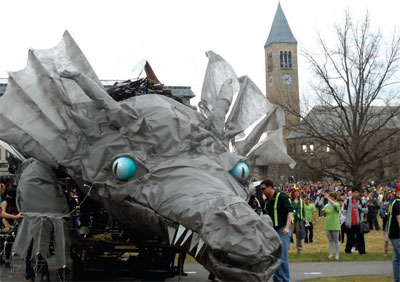
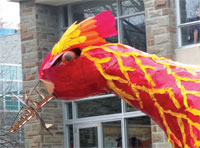 Every dragon has its day: A hundred-foot-long beast invaded the Arts Quad for the annual Dragon Day celebration in March. This year, the event happened to coincide with the Year of the Black Water Dragon on the Chinese calendar, inspiring the design. “It’s a marriage between a Western dragon and a Chinese dragon,” explains Cameron Neuhoff ’15, one of the architecture students who led the project, “with the long, serpentine aspect for most of it and the frontward bulkiness of the Western dragon.” Below right: Engineering students created the phoenix, the dragon’s traditional nemesis.
Burns Elected Dean of the Faculty
Astronomer Joseph Burns, PhD ’66, has been elected the new dean of the faculty. The Church Professor of Engineering and the former chair of the theoretical and applied mechanics department, Burns served as vice provost for engineering and physical sciences from 2003 to 2007. He defeated labor and employment law professor Risa Lieberwitz in the race to succeed outgoing faculty dean William Fry, PhD ’70, a professor of plant pathology who has held the post since 2008. “As the faculty’s representative and spokesperson at meetings with central administrators, I will be a constructive and independent voice,” Burns said in a statement prior to the vote. “I will seek to enhance faculty responsibilities for governance. I will listen to my colleagues and be a visible and vocal advocate for them.”
U.S. News Lauds Engineering Grad Programs
U.S. News and World Report’s 2013 rankings of America’s best graduate schools lists seven Cornell engineering specialties among the top ten in their respective fields. They include biological/agricultural (third), civil (eighth), electrical (ninth), and mechanical (ninth). Cornell’s MFA program rose fourteen spots to number thirty-six, while the Law School dropped one notch to fourteenth. Both the Johnson School and the Medical College were ranked sixteenth.
Bloomberg to Speak at Convocation

New York City Mayor Michael Bloomberg will give the Senior Convocation address at Cornell’s 144th Commencement in late May. The tech entrepreneur and philanthropist has held the office since 2002; in December, he named Cornell the winner of a competition to build an applied sciences campus on Roosevelt Island. (See story, page 38.) His speech will be held in Schoellkopf Stadium at noon on the Saturday of Commencement weekend; no tickets are required unless rain moves the event into Barton Hall.
Gates Hall Breaks Ground

Construction on Gates Hall, the future home of the Faculty of Computing and Information Science, began in March. The $60 million project is aimed for partial completion in time for the information science department to move into the building in January 2014, and to be finished by that spring. The building, which will be located on the site of the Hoy Field parking lot, was funded in part by a $25 million gift from the Bill & Melinda Gates Foundation. Its lead architect is Thom Mayne, the 2005 Pritzker Prize winner.
Engineering Grad Student Dies
Twenty-seven-year-old engineering graduate student Dong Quan Hao died in late February. Hao, who was studying materials science and electrical and computer engineering, served as president of the Engineering Graduate Student Association in 2009–10. The cause of death has not been publicly disclosed. In an e-mail to the college, Engineering dean Lance Collins noted that several students have praised Hao as the best TA they had at Cornell, and said that he “will be remembered for his joyful smile and his willingness to always lend a helping hand.”
Record High for Admissions Applications
In March, Lee Melvin, the associate vice provost for admissions, reported that 37,812 students had applied for admission to the Class of 2016, an increase of 4 percent over the previous year. Just over 16 percent were admitted: 6,123. Of these, 1,180 were admitted by early decision in December and 4,943 were admitted by regular admission; another 3,120 were placed on the wait list. “We’re fortunate that so many outstanding students want to receive their education here,” Melvin told the Cornell Chronicle. “Of course, that’s through a lot of hard work having gone into creating Cornell’s superb academic quality, attracting the very best faculty, and maintaining value for students and their families.”
Funds Earmarked for Gorge Safety
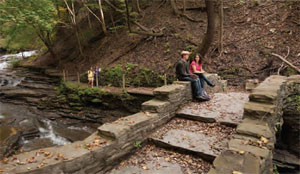
Cornell has committed to spend more than $1.5 million on gorge safety, with an additional $800,000 pending approval, the University announced in late March. The funding will allow such work as the continuing rehabilitation of the Cascadilla Gorge Trail, which was closed for safety reasons in 2009; its lower section was reopened in 2010, and the rest is expected to follow suit this fall. Planned work in Fall Creek Gorge includes the installation of new railings, fences, gates, and signs. Additionally, scenic overlooks will be built in both gorges. “We plan to put amenities there so that folks can have a place to enjoy and experience these magnificent natural landscapes,” says Todd Bittner, Cornell Plantations’ director of natural areas.
President David Skorton appointed the Gorge Safety Steering Group following three accidental deaths in August 2011. This summer, the University will launch a “gorge stewards” program in which students will be trained to educate peers about the hazards of swimming in the gorges, the regulations against it, and the legal alternatives for recreation. The safety projects are separate from the efforts to prevent suicides on gorge bridges through the installation of nets and fencing.