From the Hill
JUL./AUG. 2007 VOLUME 110 NUMBER 1

Pomp and Circumstance PRESIDENT SKORTON'S FIRST COMMENCEMENT

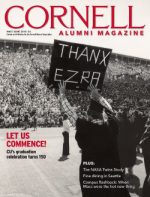
graduation"I DON'T GIVE ADVICE," SAID SOLEDAD O'BRIEN IN HER MAY 26 convocation address, which marked the beginning of the University's 139th commencement. "I don't believe in advice." The CNN correspondent warned students against listening to others and said the best lesson she ever learned was to follow her passion.

The next day, in his first commencement address, President David Skorton urged a "new type of Marshall Plan" focused on reducing global inequalities. "The role of universities in building educational and research capacity in other places is particularly important in a world that has become increasingly distrustful of the U.S. government," he told the audience of 40,000 graduates, parents, and friends. Skorton reminded the Class of 2007 of the capacity they have to make a difference in the world and emphasized the underused potential of universities on the global scale.

At the ceremony, the University awarded 3,681 undergraduate degrees, as well as 419 MBAs, 300 JDs, 1,313 master's degrees, and 728 PhDs. Some graduates added whimsical notes to the occasion, adorning their black robes and mortarboards with bright feather boas, balloons, and (in the case of the Vet grads) inflated exam gloves. Newly minted ornithology PhD Andrew Farnsworth '95 even carried a bird on his shoulder--a stuffed version of the elusive ivory-billed woodpecker.

Giving Mood NEARLY A HALF-BILLION FOR CU

IN MID-JUNE, THE UNIVERSITY ANNOUNCED THAT IT had received the single largest gift ever given to a medical school: $250 million from longtime benefactors Joan and Sanford Weill. The Weills also gave $50 million to Cornell's Ithaca campus for research in genomics and other fields, bringing their total lifetime contributions to more than $500 million.

At the same press conference, the Medical college announced several other major gifts: $25 million from the Greenberg Family Foundation, $25 million from the Starr Foundation, and $100 million from an anonymous donor. Added to previous donations, the gifts put the Medical college's $1.3 billion capital campaign halfway toward its goal. "We are grateful and humbled to be the recipient of such immense generosity," says Dean Antonio Gotto. "It is almost overwhelming."

The University's efforts in the life sciences had gotten an earlier boost in May, when President Skorton announced a $25 million gift from Nancy Schlegel Meinig '62 and Peter Meinig '61 to fund faculty research. The Meinig Family Investigatorships will offer grants of about $300,000 a year for five years.

Art Work JOHNSON MUSEUM TO EXPAND

museumIN APRIL, THE HERBERT F. JOHNSON MUSEUM OF ART unveiled plans for a major addition on the building's north side, expected to break ground in Spring 2008. The 16,000- square-foot wing will allow the display of more pieces from the museum's collection of 32,000 works and create new space for performances, lectures, and films. The three-floor annex, which will be largely underground, is scheduled to open in 2010.

The addition echoes I. M. Pei's original design for the building, which included an extension reaching to the edge of Fall Creek Gorge. At the time, it wasn't built for financial reasons; today, it would be prohibited by environmental regulations. John Sullivan III '62 of Pei Cobb Freed and Partners, who oversaw the 1973 construction of the building, designed the new space based on Pei's concept. The total cost of the project is estimated at $17 million.

Green Grade UNIVERSITY RELEASES ENVIRONMENTAL REPORT

IN MAY, THE UNIVERSITY PUBLISHED ITS FIRST "GREEN REPORT," an overview of Cornell's environmental footprint and plans to minimize its impact. The report sprang in part from a 2005 agreement with the Redbud Woods Working Group, in which Cornell pledged to improve sustainability in the wake of the controversy over the construction of a West Campus parking lot. Last spring, President Skorton announced that he would sign the American College and University Presidents Climate Commitment, which aims to reduce campus emissions of greenhouse gases to zero. The "Green Report" addresses Cornell's land and energy use, buildings, materials, transportation, and waste; it was compiled by Sustainability Coordinator Dean Koyanagi '90, BS HE '01, with the help of student and staff groups; it is available online at http:// www.sustainablecampus.cornell.edu.

Digital Donation FORMER EDITOR FUNDS SUN ARCHIVE

KEITH JOHNSON '56, A JOURNALIST WHO GOT HIS START AT the Daily Sun, is giving back to the newspaper by funding the digitization of its first fifty years. The project came about after Johnson, a former Sun editor-in-chief who worked at Time, Money, and Fortune magazines before his retirement, began researching a book on the postwar history of Cornell. During a trip to campus, he undertook the not-entirely-pleasant task of sifting through the paper's bound archives. "They're very dusty and you sneeze a lot," Johnson says. "The other peril is microfiche--your eyes fall out." The Sun digital archive is scheduled for completion this summer. The University Library is also in the process of digitizing issues of this magazine from its inception in 1899 as the Cornell Alumni News to the present; the CAM archive can be found at http://dspace.library.cornell.edu/.